An oral history of Paisley Radicals: Catalysts for Change

In March of 2020, Edinburgh-based live arts production house Civil Disobedience were commissioned to craft a creative response to the 200th anniversary of the Radical War and Paisley’s role therein by Renfrewshire Council. Courtesy of the challenges that the year presented, this project – which eventually became Paisley Radicals: Catalysts for Change – would push them to renounce any notion of a comfort zone and adapt to a whole new method of working as they veered from a stage show to walking tour.
As told to our editor by CD’s co-founder Barry Church-Woods and producer/actor Martin Maclennan, this the tale of how the Paisley Radicals App – which takes users on an interactive and riveting tour from Woodside Crematorium to Paisley Cross – was conceived, produced and delivered.
Renowned for their insightful and thought-provoking work, Civil Disobedience were approached by Renfrewshire council to tender for the job of creating a piece on the Paisley Radicals in early 2020. Little did they know, outside forces would ensure that it’d be like no job they’ve ever had before.
Barry Church-Woods: It was interesting. Because we were working with the council, it was the same sort of tender that you’d get if you were sandblasting buildings or something like that. It was a real learning curve, I think it took us about two weeks to write it and then come up with this creative idea.
It was inspired by the radical war of 1820. I didn’t know much about it, but Martin knew a little bit. I read up on it and realised ‘oh this is cool, this has a crossover with activism and the sort of stuff we do’. We wrote very much to our strengths and knew we could create this sort of work.
So much of the tender was about how we’d engage with community groups, so it wasn’t so much about saying ‘we’re going to come and do this whole production for you’, but more about the engagement experience that we had and work we’d done in the past.
I was actually working in Cyprus and while I was over there, we were seeing the first cases [of Covid 19] trickling into the UK. You could just feel the impending doom of it all. Initially, we just thought ‘oh, we’ll need to delay it because of this three week lockdown’ (laughs). Originally, the plan was to do these townhall discussions with all of the community groups to see the sort of thing that they wanted it to be and have ownership of it.
That wasn’t able to happen, so it was a bit of a slog.
Left at a temporary impasse in which community engagement was no longer possible, Civil Disobedience had to hastily regroup. But in the view of Martin and Barry, it also gave them time to digest the scope of what they were covering.
Martin Maclennan: We had a couple of initial meetings and a trip to the community centre for drop-ins. Like Barry, I went on a holiday to Glencoe snowboarding and by the time we were driving back, it looked like everyone else was locking down and the UK were taking their time over it.
I was thinking ‘what’s going to happen with the show?’ But there was so much going on. The upside of it was that I had a lot of time to read. It gave me a chance to get to what’s available, but there’s conflicting views on it. So, when that’s the case, I find it better to talk to people.
Barry: One of the really useful things that came out of it was that U3A [University of the Third Age] had already carried out a big research project into the radical wars and we were expecting to engage with them.
We only got to meet two of them at the Paisley Arts Centre, but we had a lot of great zoom calls where we got to know them and had the chance to interrogate them on all of the stories that weren’t in the textbooks. They’d dug deep. We were really keen to identify the women who’d been written out of history and they filled that in for us.
Ultimately, we had to come to the main story because we needed to hear what happened and there wasn’t a huge amount of room for subtext, but it was still great to get all that.
We got to spend time with them on Zoom after a while. Initially, groups like Star Project were just learning to use this technology and looking into the structure of meetings etcetera.
After a while, we got set up with the Star Project to do a lot of creative writing while Jo Ronan, who was the head of performance art at the University of the West of Scotland at that time, basically brought us in as guest lecturers for their devising unit.
It was in partnership with their new media department as well, so the idea was that we’d work with six different groups of students – some performing arts, others new media – and they’d collaborate on the themes that came up.
Very few of their pieces really bled into the radical war per se, but it did allow us to start thinking about the modern day parallels. Stuff like right to assembly, Black Lives Matter, Take Back the Night, Hong Kong, all of these things were happening in the background while we were talking about this stuff from 200 years ago. It’s all actually happening right now.
Martin: As lockdown looked like it was going to continue for a while and began to feel quite indefinite, the meetings with the groups were something that I really looked forward to.
I felt so bad for the young people that we were engaging with, you’ve got those couple of years where going out is really good and the relationships with your friends are never more intense. But, they got engaged with it.
I’ve still never met the Star Project people in person, but they feel like people I’ve gone through the lockdown with (laughs). I look forward to meeting them one day, we’ve spoken about meeting up to do the walking tour together.
It was a community project so at the time, it felt like we were getting short changed because we couldn’t go out and meet people in Paisley. Looking back, everyone that we worked with was so generous with their time, their knowledge and their skills.
The songs and things like that became such a key part of the project as a whole, so it’s great to know that I’ve worked with people that I might not have otherwise.
Barry: The work we did with the Star Project was very much thematically based on talking about an event from the radical wars and then they’d go off and write a creative response to it in any medium.
By the end of the first six weeks, we had a lot of really great writing and a lot of the powerful stuff that came through was poetry, so we turned that into music. We engaged [musician] John Kielty who helped with this process and this was eventually rearranged for the production.
Far from being confined to the nation’s capital, Civil Disobedience enlisted a contingent of local actors to help bring their script to life. Namely, Mill alumni and recent star of Michael Caton-Jones’ Our Ladies, Martin Quinn and Lynda Lyon. In both instances, their arrival had a massive impact on the project.
Barry: Martin Quinn was just one of those brilliant people that I fell in love with before I even met him. The advert went up on Creative Scotland and I think he was the first person to apply.
We try to do this thing at Civil Disobedience where it’s not about class, access, privilege or training ,so we don’t want to hear from agents and don’t need fancy headshots. All we want is a wee message and a voicemail.
Basically, all you have to do is entertain us. He sent a selfie from his bedroom and a voice reel that wasn’t even a monologue but just him being like ‘hey, I’m Martin’ (laughs). We were like ‘this is great, but we do actually need a monologue as we need to assess you against other performers!
Of course, he has this great body of work so we didn’t even know if we could afford him but before we even did the casting, we were like ‘there’s this guy Martin Quinn we have to get him.’
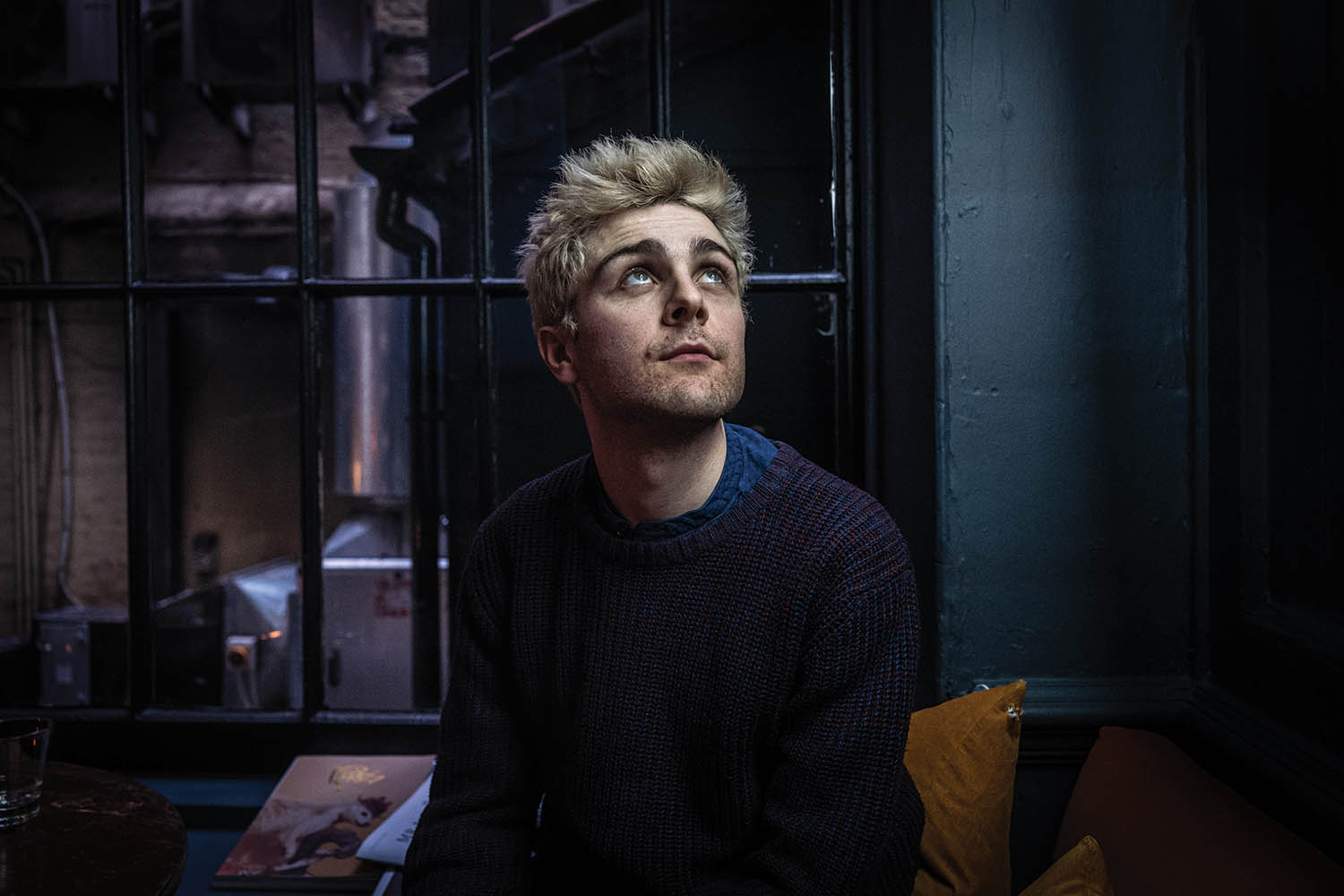
Martin Quinn, photo ©Joseph Lynn
Likewise, Linda Lyon, who’s also from Paisley but lives out in Greenock now, wrote this beautiful monologue about Covid that delved into anxiety and things like that. It was really transparent and it just moved me as I thought, ‘this is a woman who really knows who she is and she’s not afraid to let people see it.’
Before we even started writing the script, we knew that those two were going to be at the centre of this. He’s going to be the cheeky wee gadgie and the Oor Wullie-esque scamp and she’s going to be the mindful voice that carries you through the journey and enables you to take stock of your place in the world.
Everything else just kind of fell into place once we started writing. We naturally attached ourselves to those people. Martin wrote most, if not all, of the history and flashbacks whereas I wrote the pieces together and created the structure of what the show would’ve been. But yes, they were definitely front-and-centre of how we wanted it to take shape.
The other actors are people that we know or work with already. Martin is in it as he’s a great actor and Chris Gorman, who is our musical director or sound designer for this piece, did lots of stuff.
We’d say ‘we need something for the policeman reading the riot act, can you try and future it out?’ And he’d be punching himself in his hallway and throwing things against the wall (laughs).
Despite the fact that the piece was entrenched in historical fact, the duo soon realised that commonality with pertinent themes in today’s world were arriving in real time.
Martin: It was certainly the case with me. There’d be times where we’d be saying ‘ok, what are we going to do with the workshops this week? Then boom! There’s an insurrection in America.
The radical war was actually known as the Scottish insurrection and then suddenly insurrection was a dirty word that we couldn’t use in the script in case people got the wrong idea!
Barry: There were so many moments that felt like kismet in terms of what was happening socially. Particularly all of the Priti Patel, right to assembly stuff as well as George Floyd and Black Lives Matter.
Literally just as we were changing this from a show to an immersive app, people were outside UWS graffiting the statue of John Witherspoon because he was a slave owner.
Ultimately, the key theme was the right to protest and the government coming down to try and curtail your freedom of speech. That was really what the radical war was all about.
After spending months engrossed in it, the question of whether the Paisley radicals and the martyrs of this war were displaced in history came up. In particular, the fact that it is seldom mentioned in the vein as other events and isn’t embedded into any educational curriculum.
Martin: I find it particularly funny because normally, we’re not shy of lauding these types of people in Scotland. History just repeats itself. People get bored when they hear about the corn laws but you can compare it with what’s happening with the internal market now.
It all just goes back round again. I quite like my history but I basically knew nothing about it. I knew there was a martyrs monument in Edinburgh, but I didn’t know what they were martyrs for. In Scotland, you think religious martyrs but we didn’t know that we have these political ones that are heroes.
The turnaround is interesting as the monument to them went up at a time when some people would still remember. So, going from tried, hung and beheaded to having a monument a generation later is crazy. Like, wasn’t that considered an extreme reaction at the time?
Barry: It’s crazy that it isn’t taught in schools. Once we started delving into it, the conversations that we were having in the pub or the park were often ‘do you know about this?’ Then someone would be like ‘well I kind of knew that but I didn’t get this.’ Some people in Paisley knew about Miekelriggs Muir, but fewer than you’d think!
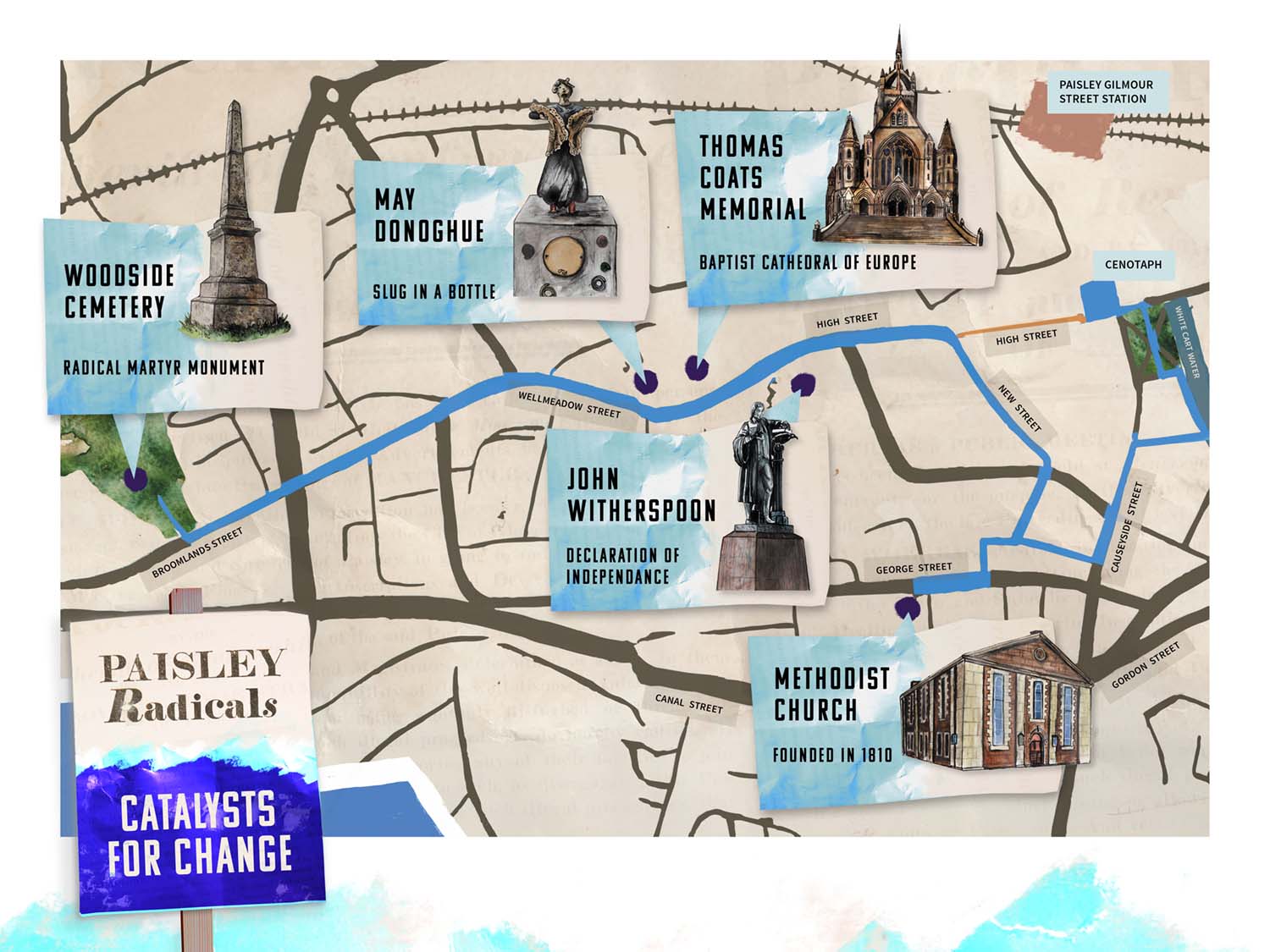
Paisley Radicals: Catalysts for Change map, Illustrated by Josef McFadden
Unveiled on the 3rd July 2021 (or Sma’ Shot Day to locals), Paisley Radicals: Catalysts for Change is now available to the world en masse. When talk turns to the legacy of the project and their evaluation of it, Barry and Martin are thrilled with how it turned out and believe that, should the stars align, there’s room to merge their original concept with their social distancing-mandated outcome.
Barry: Ultimately, there’s always stories that we don’t get to tell. We even discovered other things after the script was written. As it stands, we’ve created a fit-for-purpose, Covid-safe product.
You can put headphones on and immerse yourself in the story. It’s a period in history that we’d love to get people engaged with. Somewhere down the line, I’d love to revisit the original plans and I think there’s space for a hybrid of the app and performance but as it stands, we feel it stands alone.
Martin: I think we’ve got a product that can appeal to anyone. To write a tour that would make someone feel as though they’re being lectured at is not what you’re trying to do when you’re a- trying to entertain and b- trying to educate.
Barry: I’m really proud of it. For what was supposed to be a theatre piece with a community cast of 100, which would’ve been much easier for us as it’s what we normally do, I think it turned out great and I’d love to hear what people think of it.
We’ve ended up with something that, both ethically and morally, sits great with what we do. There’s so many great moments where people are giving their experiences of activism and the finale of the piece is incredible with Martin doing a big monologue and then it has this beautiful orchestration.
Honestly, I cried when I first heard it altogether as I realised that ‘this is what people are going to experience.’ Managing to do that in an artform that’s different from what we normally do is something I’m happy with. So much of it reflects our other work in the sense that there’s always a provocation for people to think what they can do next and we’ve retained that
Paisley Radicals: Catalysts for Change can be downloaded for Apple or Android now via Guidigo. We’d encourage all of our readers to get out there and engage with this prescient and informative piece of art that will recontextualise everything you think you know about the locations it covers.