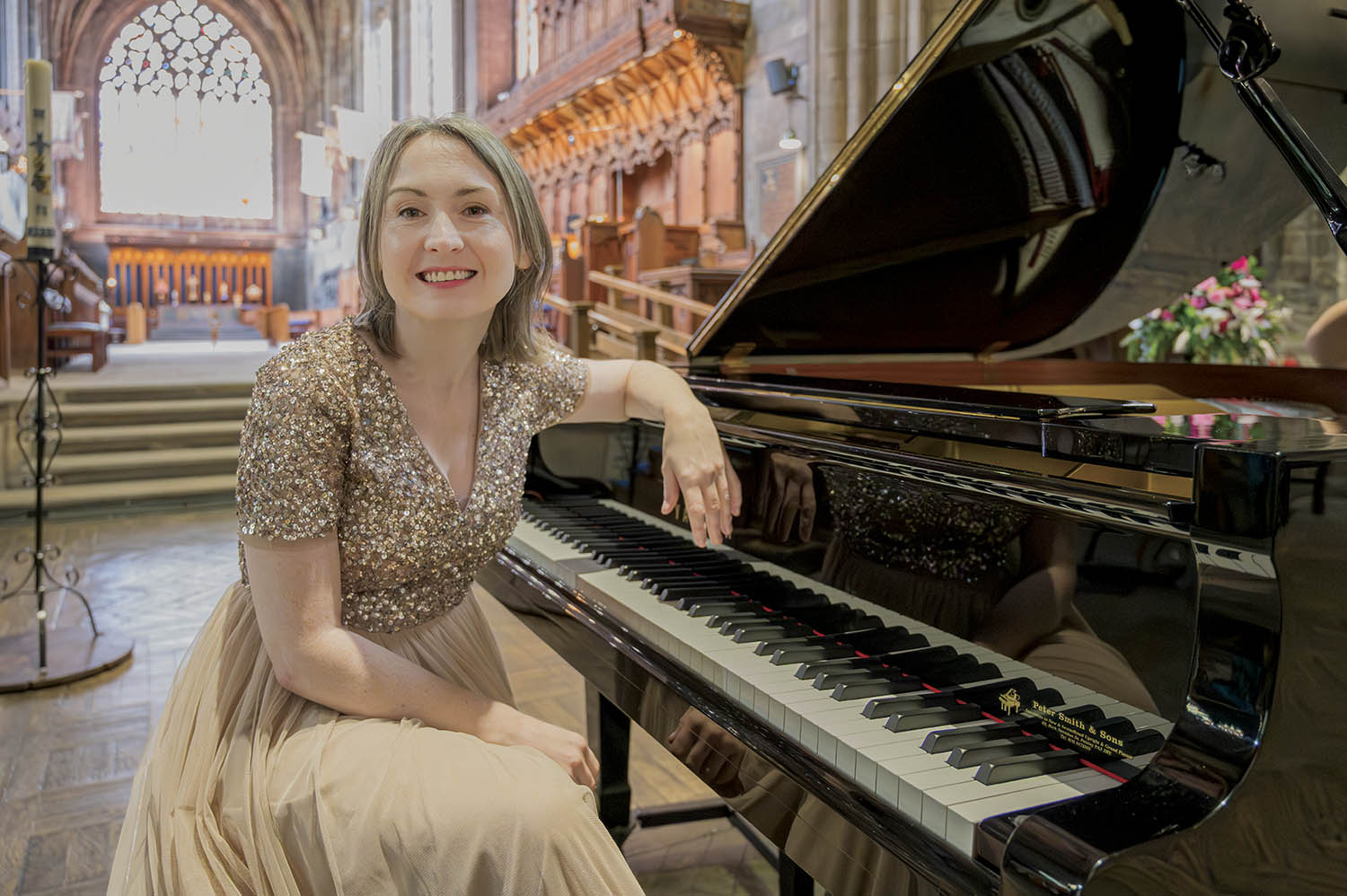
Toni James: Paisley’s piano extraordinaire talks to Mill Magazine

Born and raised in Paisley, piano extraordinaire, performer and renowned academic Toni James lifts the lid on her multi-faceted, two and a half decade career
Toni James, what first drew you to the piano and how did it progress to where you’re at now?
It’s kind of improbable in some ways. Getting to that elite level and playing on world famous stages was something I never imagined because truly, I just enjoyed it. There was a piano at my grandmother’s house and apparently, I was noodling around and picking out tunes from the age of 4 or 5.
Then, some years later, she pushed my mother to get me a teacher and we didn’t know where to begin but eventually, someone in our church started me on the path. I went to the junior academy of what is now the Royal Scottish Conservatoire when I was 11 and that felt like a huge deal at the time as I didn’t really know anyone else doing that.
When I went into the undergraduate programme, I was only 16 so at the time, I was the youngest graduate when I left at 20. I hate bringing that up, but I was hellbent on what I wanted to do and that’s how everyone who knew me then remembers me. Nothing was going to stop me from doing it.
Over the course of your career, you’ve performed at Carnegie Hall, Weill Recital Hall, Kodak Hall at Eastman Theatre, Jordan Hall, Rolston Recital Hall, Shalin Liu Performance Center, Bing Concert Hall and Copley Symphony Hall to name a few as a concert pianist. How does it feel to have achieved all of this in the classical world?
Sometimes it all feels like a bit of a blur, but it’s obviously amazing. I gave my first professional concert at 14 and I’ve loved it, but it’s definitely been a challenge at times. For a long time, I was performing as part of a trio and then after I got a job at the University of San Diego, I’ve never truly come back to being a concert pianist.
There’s some people who seem desperate for me to do it and I tentatively have a new CD project coming, so I’m currently trying to carve out time to do that amid all my other responsibilities. I’ve been recording with Alison McNeill [soprano] and we have some stuff that we should be finishing up soon before I focus on my solo disc.
I’m really excited about it. It’s a privilege, really, when I think of all the people I’ve performed with and places I’ve played in. Then as a producer and programmer, I love that I’ve had the chance to create platforms for new artists too and that’s been just as rewarding as my own career as a performer.
- Munro’s Restaurant dinner review by Suzanne Oswald
- Kustom Kruizers: Renfrew’s extraordinary bike shop
- MrdB: The Sound of Renfrewshire
Touching on that, you’ve recently undertaken a lot of work in the third sector after years working for universities across the world. How did this all come about?
People often say I moved out of education. But, the truth was that I moved out of academia. I was very drawn to the charitable sector and took on various voluntary roles, whether it was programming festivals or running organisations. This led me to take a job in Jersey as Development and Operations Officer for Music In Action, their leading arts organisation.
Leading arts and culture is what I love to do, but I’ve been doing a lot of work recently which has been working across social dimensions, including projects which would help the refugee community as well as those from low income areas who are socially or culturally deprived. It’s shocking that we’re in 2025 and we’re still not anywhere near an equal provision of the arts, particularly when it comes to class backgrounds.
Is this something that you hope to address through your work?
Yes, I’ve become so passionately involved in that. Recently, a friend sent me an article which was about the BBC Young Musician of the Year Award, something which I was a keyboard finalist for back in the day. That put me in a very small group of people that wasn’t privately educated or in full time music school or came from an affluent background.
In the most recent line-up, it showed that music education is in crisis as last year, none of the semi-finalists came from a state school and that’s 20 years after my own experience. Unfortunately, it suggests we’re going backwards and to me, that’s unacceptable. It’s insane and I’m working on a few things at the moment to try and get some investment into areas where that kind of career otherwise wouldn’t be realistic.
Granted, I didn’t think it was realistic? How many concert pianists do you know that come from Paisley? (laughs) But I think that’s a real shame in a way.
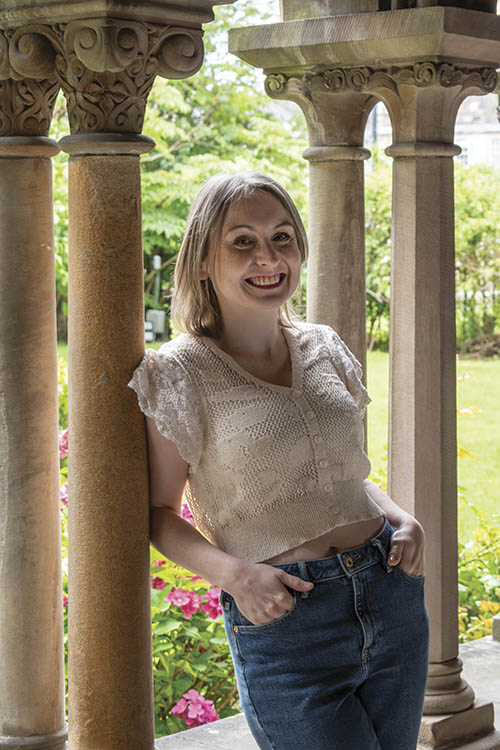
Toni James, photo by Karen Honeyman
What do you believe is the answer to this?
Well, I do worry about the over-reliance of funding, because it puts us at the mercy of political changes. Just look at last year when we nearly lost the creative fund and individual fund at Creative Scotland. If we can’t pursue other successful avenues for investments, we’re essentially putting all our eggs in that one basket and that’s not a sustainable model to deliver culture.
There’s still so much that’s gatekept in terms of who gets to do what. In my experience working across it, you see a lot that you can’t unsee when it comes to the challenges people face. So, hopefully some changes can help to move the needle, because the needle is stuck.
On our local level, It’s fascinating to see everything that’s happening with the investment of the cultural portfolio in Renfrewshire and no-one would say that isn’t a very positive thing. But, I always think there’s room for more investment in not just the physical structures or the buildings, but the people who will inhabit them into the future. That’s still an uneven picture across the board.
Tell us about your experience working to deliver the Tannahill Arts Festival. Was that an experience that you’re particularly proud of?
Very much so, it was such an amazing grassroots experience working with a lot of local artists. For me, the hallmark of its success was that it was a product of so much local activity that was already going on. That’s a model that I feel is effective, when things are born out of the community and that type of activity.
I’ve stepped away from the board as I was on it for a number of years and felt it was time for a change, but hopefully there’s another one on the way. I’d love to do more in Paisley and I’m certainly watching with interest.
Q&A with Toni James
Where do you like to visit when you come back to Paisley?
I love all the coffee shops so you can’t make me pick! Walking through the centre of the town is amazing as I get to see the changes and get to enjoy the older aspects of the architecture too.
What music do you like that people wouldn’t expect you to enjoy?
It’s very mood driven for me and I think people have a very narrow view of classical music. There’s so much incredible music now that’s much better categorised by different genres.
So, we need to get away from that stale view of it. So, I’d encourage people to expand their view of what classical music is. But, beyond that, I love good singer-songwriters. Jason Isbell is someone I listen to a lot, a lot of Americana. I have been known to like country and western too!
To find out more about Toni James, visit her website. Thank you to the management and staff at Paisley Abbey for allowing us to take photos of Toni in their incredible building.